

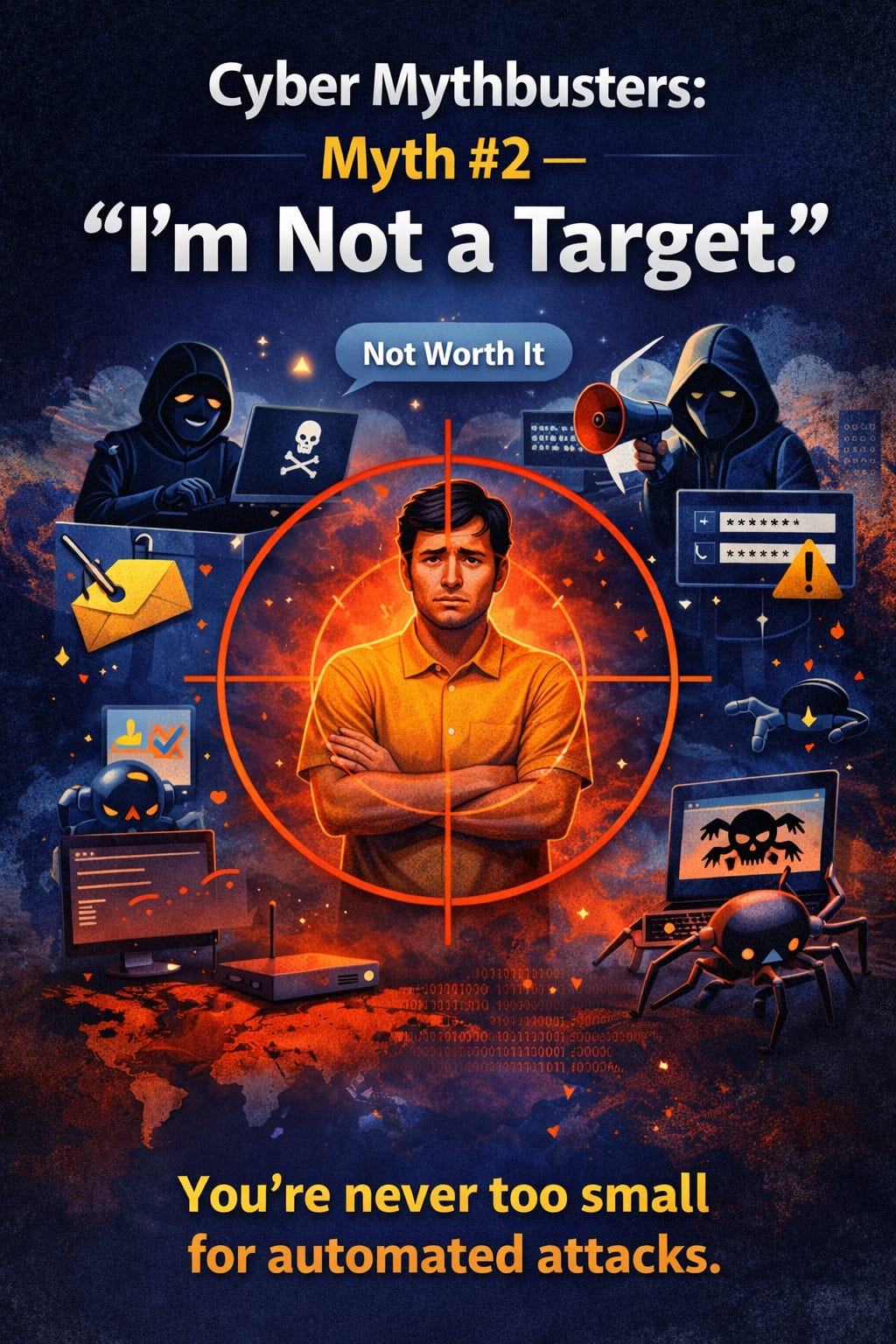
Many everyday internet users — people who don’t consider themselves wealthy, high‑profile, or interesting — believe they aren’t worth a hacker’s time. It’s a comforting idea, but it’s not supported by the actual data behind modern cyberattacks.
Today’s attacks do not rely on who you are. They rely on how easy you are to compromise.
This myth persists because people picture cybercriminals manually choosing high‑value targets. But in reality, most attacks are automated, indiscriminate, and designed to hit as many ordinary users as possible.
What follows is a clear, fact‑driven breakdown of why “I’m not a target” is no longer a safe assumption online.
The Myth
The belief usually sounds like:
“Hackers only go after big companies.”
“I don’t store anything sensitive online.”
“If I’m not rich, why would someone bother with me?”
“Cybercriminals don’t know who I am.”
This reasoning misunderstands how attacks actually work in 2026.
The Reality: Automated Attacks Target Everyone
Most cyberattacks are automated — not personal. Automated bots now make up over 50% of all web traffic, surpassing human activity for the first time in a decade according to the 2025 Imperva Bad Bot Report. Fastly’s 2025 Threat Insights Report also found that 37% of all global internet traffic is bot-driven, with much of it classified as malicious or unwanted activity, including account takeovers and data theft
These automated systems scan the entire internet constantly. They don’t target individuals — they target any device, account, or service with a weakness.
You are not attacked because of who you are.
You are attacked because bots never stop looking for vulnerabilities.
3. Phishing campaigns hit everyone, not specific people
Phishing remains the world’s dominant initial access vector. According to aggregated data from IBM, Verizon, and other major cybersecurity reports, over 3.4 billion malicious emails are sent every day worldwide.
Additionally, the human element, including phishing or credential theft, played a role in approximately 60% of all confirmed breaches in recent data from Verizon’s DBIR.
This scale is only possible because attackers send massive waves of messages to millions of people at once. Anyone with an email address is inside the blast radius.
Phishing works because it doesn’t need to be personal.
4. Attackers rely on old, leaked, and reused passwords
The 2025 Verizon DBIR reported that 68% of breaches involved the human element, including reused or compromised credentials.
Attackers use automated tools to:
Test old leaked passwords against new accounts
Attempt logins across multiple platforms
Exploit reused credentials across banking, email, and social media
If a password you used in 2016 leaked in a public breach, bots are still testing it today. This has nothing to do with your profile — it’s simply automation doing its job.
5. Your devices are scanned constantly
Web scanner bots often represent the first and most frequent visitors to any new website, sometimes accounting for up to 70% of early traffic during initial days, as reported by HUMAN Security’s threat intelligence research.
The same automated scanning happens on home networks. Bots try to exploit:
Outdated routers
Unpatched smart devices
Exposed ports
Weak home Wi‑Fi passwords
Old operating system versions
If a device is online, it is being tested for weaknesses — typically within minutes of connecting.
You don’t need to be hunted.
Your IP address is already checked routinely.
Why Everyday Users Are Easier Targets
Ironically, ordinary users are often more profitable to attackers than high‑profile targets.
Attackers know that the average person:
Reuses passwords
Rarely audits old online accounts
Doesn’t update devices promptly
Is more likely to click a convincing message
Doesn’t expect to be attacked
Lacks enterprise‑grade monitoring or protections
This combination makes everyday users easy and efficient opportunities for cybercriminals operating at scale.
How to Make Yourself a Harder Target
You don’t need to be unhackable — just harder to hack than the lowest‑effort targets automated systems are built to exploit.
A few high‑impact habits include:
Use unique passwords
Prevents attackers from reusing leaked credentials.
Enable multi‑factor authentication (MFA) everywhere
Dramatically reduces account takeover attempts.
Keep devices updated
Patches close vulnerabilities bots routinely scan for.
Be skeptical of unexpected messages
Phishing remains successful because it exploits human reaction, not technical flaws.
Remove or secure outdated accounts
Old login credentials are among attackers’ favorite entry points.
Small actions change your risk profile significantly
Final Takeaway
The idea that “I’m not a target” made sense twenty years ago, when cyberattacks were largely manual. But in 2026, the numbers tell a different story:
Most web traffic is automated bot activity
Over one‑third of global traffic is malicious automation
Billions of phishing emails are sent daily
Human error contributes to the majority of breaches
Attackers do not need to know who you are.
They only need you to be unprepared.
But with simple, consistent habits, everyday users can protect themselves better than most — and avoid becoming the low‑effort targets automated attacks are designed to exploit.
Next Week on Cyber Mythbusters
Myth #3 — “Strong Passwords Are Enough.”
We’ll explore why even the strongest password can fail on its own — and what truly protects your accounts in 2026.