

If you are new to cybersecurity—or preparing for certifications such as CompTIA Security+ or CompTIA CySA+ — this series is designed for you.
Many people enter cybersecurity expecting to start with tools: firewalls, SIEM dashboards, malware analysis, or threat hunting. While those skills are important, they are not where security actually begins. Real-world cybersecurity starts long before alerts, incidents, or attacks, with leadership decisions, policies, and risk management.
This series breaks down cybersecurity the way it works in practice, not just how it appears on an exam.
Why This Series Starts with Governance and Risk
A common mistake among beginners is assuming that more technology automatically means better security. In reality, organizations frequently experience major breaches despite heavy investment in security tools.
The reason is simple:
Technology alone does not create security.
Management, policy, and risk decisions do.
Security tools only become effective when they are:
selected based on real risks,
deployed intentionally,
governed by policy,
and measured through clear objectives.
This series begins by establishing that foundation so everything that follows—vulnerability scanning, incident response, threat detection, and automation—has real context.
Governance: How Security Decisions Are Made
Technical definition:
Governance is the structure by which leadership directs and oversees cybersecurity strategy through policies, processes, and accountability.
Simple definition:
Governance is who decides what security looks like and how those decisions are enforced.
Governance teams translate risk information into direction. They define priorities, approve policies, and determine acceptable levels of risk. Without governance, security becomes reactive, inconsistent, and ineffective—regardless of how advanced the technology may be.
Policy: The Blueprint for Consistent Security
Technical definition:
A security policy is a formal document that defines rules, expectations, and required behaviors for protecting systems, users, and data.
Simple definition:
Policy is the rulebook that keeps security consistent—especially under pressure.
Well-defined policies:
remove guesswork during incidents,
guide SOC analysts during high-stress situations,
ensure work is repeatable and auditable,
and form the foundation for compliance and accountability.
In practice, strong policies allow security teams to act decisively instead of improvising during critical moments.
Measuring Security: Service-Level Objectives (SLOs)
Security cannot improve if it is not measured.
Technical definition:
Security Service-Level Objectives (SLOs) are measurable performance targets used to assess the effectiveness of security operations.
Simple definition:
SLOs are how organizations know whether security is actually working.
Common examples include:
Mean Time to Detect (MTTD)
Mean Time to Respond or Recover (MTTR)
Time to Patch vulnerabilities
These metrics connect day-to-day security operations with leadership oversight and business expectations.
Risk Management: The Core of Cybersecurity
You Can’t Eliminate Risk — Only Manage It
Technical definition
Risk management is the process of identifying, assessing, prioritizing, and responding to risks to reduce their likelihood or impact to acceptable levels.
Simple definition
Risk management is choosing which problems to fix now, later, or not at all.
Every organization has risk. The goal is not perfection — it’s control.
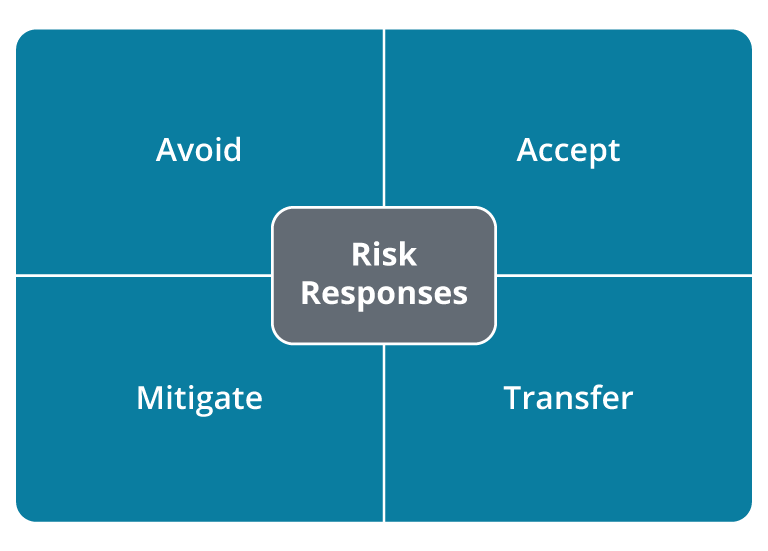
The Four Risk Responses (Memorize These)
1. Avoid
Technical: Eliminate the activity causing the risk.
Simple: “This isn’t worth it — shut it down.”
Example: Decommissioning a vulnerable legacy system.
2. Accept
Technical: Acknowledge the risk and continue operating.
Simple: “We know the risk and we’re okay with it.”
Example: Low-impact vulnerabilities with no feasible fix.
3. Mitigate
Technical: Reduce risk using controls.
Simple: “Make it safer.”
Example: Adding WAFs, MFA, patching, monitoring.
4. Transfer
Technical: Shift financial risk to a third party.
Simple: “Someone else pays if this goes wrong.”
Example: Cyber insurance.
Security Controls: Not Just Firewalls
Control Categories (the who)
Technical – systems and software
Operational – people and processes
Managerial – oversight and governance
Control Functional Types (the when)
Preventive – stop attacks
Detective – notice attacks
Corrective – fix damage
Compensating – substitute controls
Responsive – guide incident actions
Simple takeaway
Real security uses multiple controls, at multiple layers, for multiple purposes.
One firewall is not a strategy.
These responses appear repeatedly in both Security+ and CySA+, and understanding them early is critical.
Threat Modeling: Thinking Before the Attack
Threat modeling identifies:
who might attack an organization,
how those attacks are likely to occur,
and where defenses are most needed.
By analyzing systems from both attacker and defender perspectives, threat modeling helps security teams build realistic monitoring, detection, and response strategies. This ensures defenses are aligned with actual threats, not theoretical ones.
Attack Surface Management: Reducing What Can Be Attacked
Technical definition
An attack surface is the total set of exposed systems, services, protocols, users, and configurations that could be exploited.
Simple definition
The attack surface is everything an attacker can touch.
This includes:
Internet-facing systems
cloud resources
remote users
shadow IT
misconfigurations
weak passwords
Reducing the attack surface means:
Asset inventory—Conducting an inventory of all hardware and software assets and user accounts in the environment. Once identified, the team must determine which assets are essential for business operations and which can be removed.
Access control—Implementing strict access control measures, such as multifactor authentication, can reduce the attack surface significantly. Limiting access to sensitive data and systems reduces the risk of unauthorized access.
Removing Unnecessary Systems-Removing hardware or software components reduces the attack surface. By removing software, the organization eliminates a pathway that attackers can exploit.
Patching Aggressively-Regularly patching and updating software and firmware can prevent attackers from exploiting known vulnerabilities.
Segmenting Networks-Segmenting a large network into smaller subnets can limit the damage an attacker can cause. Thereby reducing the attack surface.
Training Users/Employees- Employee training can help reduce the attack surface by raising awareness of the potential risks and the importance of security measures. Regular training can help employees recognize and report potential security threats, reducing the likelihood of successful attacks.
Less exposure = fewer successful attacks.
An organization’s attack surface includes every system, service, user, and configuration that could be exploited.
Patch & Configuration Management: Boring but Critical
Technical definition
Patch management ensures vulnerabilities are fixed consistently and safely.
Configuration management enforces secure system settings at scale.
Simple definition
Patching fixes holes. Configuration keeps them from reopening.
Key ideas:
centralized management
testing before deployment
different priorities for critical systems
logging and verification
Tools like Ansible, Chef, Puppet, and Terraform make security repeatable, not manual.
Maintenance Windows: When Security Gets Tricky
Technical definition
A maintenance window is a scheduled period for system changes that comply with change management policies.
Simple definition
Maintenance windows are planned chaos.
Why they matter:
alerts spike
systems restart
attackers may hide activity
SOC must know what’s expected vs suspicious
Security doesn’t pause during maintenance — it must adapt.
Patch management and configuration management are foundational security practices. While often viewed as routine or unglamorous, they directly prevent many of the most common attacks.
Security does not pause during maintenance—it must adapt.
Who This Series Is For
This series is intended for:
individuals new to cybersecurity,
students preparing for CompTIA Security+,
professionals advancing toward CompTIA CySA+,
and anyone seeking a structured, real-world understanding of cybersecurity operations.
The goal is not memorization, but comprehension—understanding how governance, risk, and technical controls work together to form an effective security program.
Moving Forward
This introduction establishes the foundation for the rest of the series. Future entries will build on these concepts and explore vulnerability analysis, incident response, threat detection, automation, and secure development practices.
By the end of this series, readers should not only be prepared for certification exams, but also equipped with a practical understanding of how cybersecurity functions in modern organizations.