

Lesson 4: Process Improvement in Security Operations
(CySA+ CS0-003)
By now, the structure of security operations should feel clear.
Lesson 1 explained why security exists — governance, policy, and risk.
Lesson 2 showed us who is attacking — threat actors and intelligence.
Lesson 3 defined what we’re protecting — systems, identity, and logging.
Lesson 4 answers the operational question:
How do we run security efficiently at scale?
Because once an organization grows, manual security operations break down fast.
Why Automation Becomes Necessary
Imagine reviewing thousands of logs manually every day. Copying IP addresses into threat databases. Opening tickets one by one. Disabling accounts individually.
That works at small scale.
It fails at enterprise scale.
Technical Definition — Automation
Automation in security operations is the use of technology to perform repetitive detection, analysis, and response tasks with minimal human intervention to improve efficiency, consistency, and accuracy.
Simple Definition
Automation lets tools handle repetitive work so analysts can focus on real investigations.
Automation directly improves:
Mean Time to Detect (MTTD)
Mean Time to Respond (MTTR)
Response consistency
Error reduction
For CySA+, understand this clearly: automation is about operational maturity, not convenience.
SIEM: Turning Logs Into Intelligence
In Lesson 3, we discussed logging across systems — firewalls, endpoints, cloud platforms, authentication services.
But logs are useless if they live in isolation.
That’s where SIEM comes in.
Technical Definition — SIEM
A Security Information and Event Management (SIEM) system aggregates, normalizes, correlates, and analyzes log data from multiple sources to detect potential security incidents.
Simple Definition
A SIEM collects logs from everywhere and connects the dots.
For example:
Multiple failed logins
Followed by a successful login
From an unusual geographic location
Individually harmless. Together suspicious.
That pattern recognition is correlation — a core SIEM function.
For the exam, remember:
SIEM detects and alerts.
It does not primarily automate full response workflows.
SOAR: Automating the Response
Now let’s say the SIEM flags suspicious behavior.
What happens next?
Without automation, an analyst must:
Investigate
Enrich the alert
Block IPs
Disable accounts
Open tickets
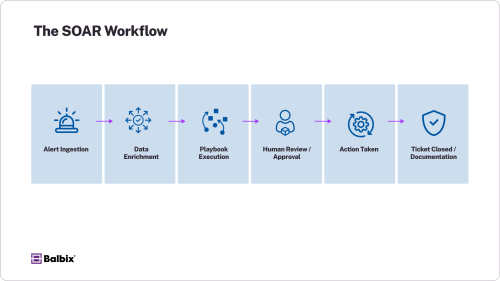
With SOAR, that workflow can be automated.
Technical Definition — SOAR
Security Orchestration, Automation, and Response (SOAR) platforms integrate security tools and automate incident response workflows through predefined playbooks.
Simple Definition
SOAR automatically handles the response after detection.
It might:
Block a malicious IP
Isolate an endpoint
Disable a compromised account
Notify the team
If SIEM finds the problem, SOAR executes the plan.
For CySA+, this distinction is critical.
SIEM vs SOAR (At a Glance)
4
Think of it like this:
SIEM = Detection and visibility
SOAR = Orchestrated response and automation
Both work together in mature security operations.
Threat Intelligence in Action
Back in Lesson 2, we introduced Indicators of Compromise (IOCs).
Technical Definition — IOC
An Indicator of Compromise is forensic data that identifies potentially malicious activity on a system or network.
Simple Definition
An IOC is a clue that something bad may be happening.
Examples:
Malicious IP addresses
Known bad file hashes
Suspicious domains
Lesson 4 shows how automation makes intelligence actionable.
Instead of manually checking IOCs, a SIEM can:
Ingest threat feeds
Compare them against internal logs
Trigger alerts automatically
That’s operationalized intelligence.
Enrichment and Correlation: Adding Context
An alert without context is noise.
Technical Definition — Data Enrichment
The process of combining data from multiple disparate sources to add context and improve understanding of an event.
Simple Definition
Enrichment adds extra information to make alerts smarter.
Technical Definition — Correlation
The process of identifying relationships between events across systems to detect patterns of malicious activity.
Simple Definition
Correlation connects separate events into one bigger story.
Together, enrichment and correlation transform raw logs into meaningful intelligence.
These are high-value exam terms — know them well.
Single Pane of Glass
As organizations adopt more tools, visibility becomes fragmented.
A Single Pane of Glass solves that.
Technical Definition
A unified interface that provides centralized monitoring and visibility across multiple systems.
Simple Definition
One dashboard to see everything.
It reduces friction, improves response speed, and increases operational awareness.
APIs and Webhooks: The Integration Backbone
None of this automation works without integration.
Technical Definition — API
An Application Programming Interface (API) is a defined set of rules that allows applications to communicate and exchange data.
Simple Definition
An API lets security tools talk to each other.
Technical Definition — Webhook
An event-driven HTTP callback that automatically sends data to another application when a predefined event occurs.
Simple Definition
A webhook sends an automatic message when something happens.
Example:
Alert triggers → webhook sends data → SOAR playbook starts immediately.
This is orchestration in action.
Orchestration: Coordinated Automation
Technical Definition
Orchestration is the coordinated management of automated workflows across multiple integrated security tools.
Simple Definition
Orchestration makes all the tools work together in one smooth process.
SIEM detects.
SOAR responds.
Firewalls block.
Endpoints isolate.
Tickets open automatically.
That’s operational maturity.
The Bigger Picture
Lesson 4 is where everything connects.
Governance defines expectations.
Threat intelligence identifies risks.
Logging provides visibility.
Automation enforces consistency.
Security maturity isn’t about having the most tools.
It’s about:
Defined processes
Integrated platforms
Intelligent automation
Continuous improvement
For CySA+, focus on understanding relationships:
SIEM vs SOAR
What enrichment and correlation mean
What an IOC is
How APIs and webhooks enable automation
Why automation reduces detection and response time
If you can explain those clearly — both technically and simply — you’re solid for this section.
Conclusion
Security operations is not just about finding threats — it’s about responding to them quickly, consistently, and intelligently.
Lesson 4 shows us that mature security programs rely on more than alerts. They rely on structured processes, integrated tools, and automation that reduce human error and speed up response time. SIEM provides visibility. SOAR executes the response. Enrichment and correlation add context. APIs and webhooks connect everything together.
When governance defines the rules, intelligence identifies the risks, and logging provides visibility, automation is what turns strategy into action.
That’s what operational maturity looks like.
And that’s what CySA+ expects you to understand.