

When business owners think about cybersecurity risk, they usually imagine an external threat.
A hacker.
A phishing email.
A data breach that comes out of nowhere.
What they rarely consider is the quieter truth:
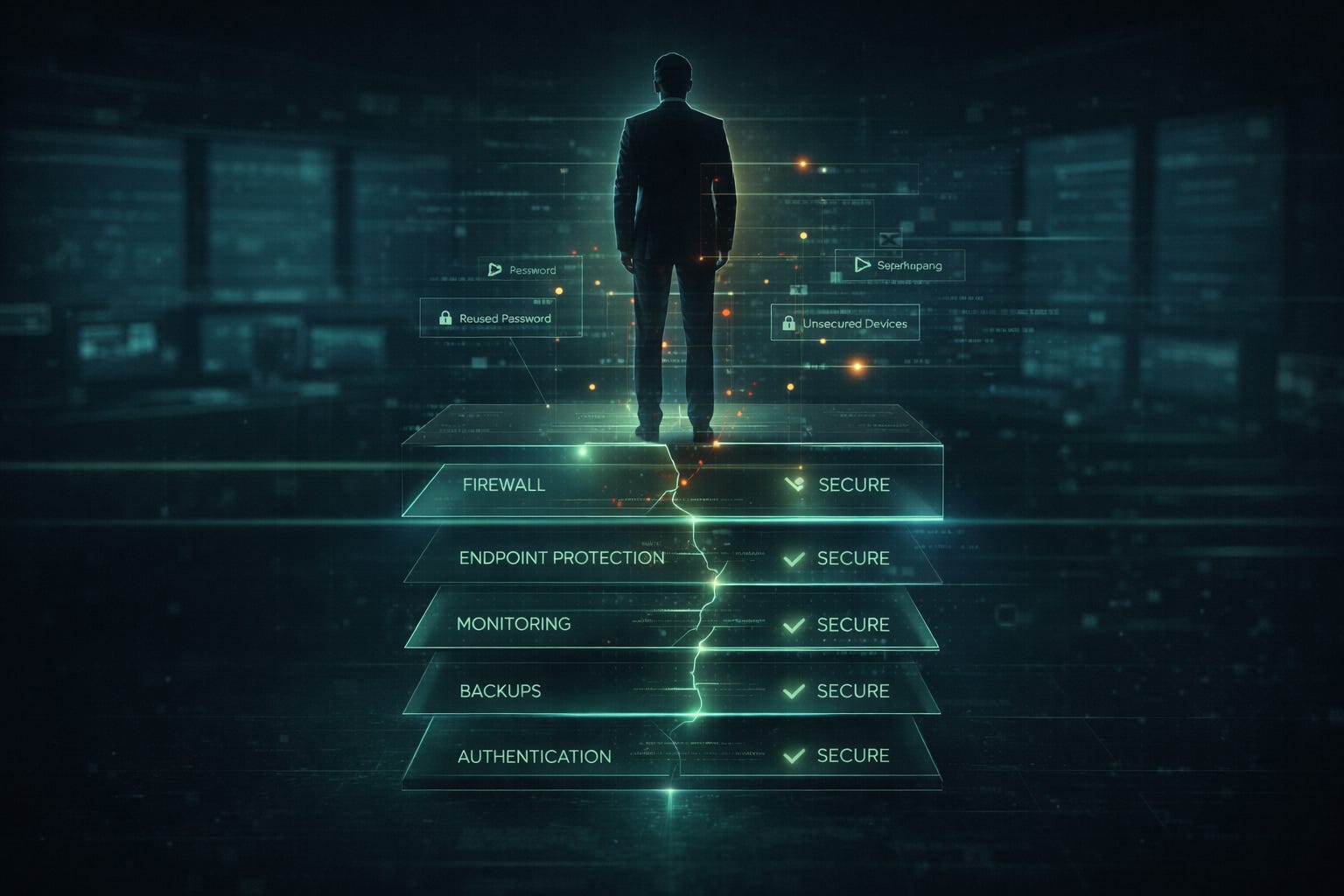
Most security failures don’t come from malicious outsiders — they come from stressed, overloaded operators making reasonable decisions in broken systems.
And in most businesses, the primary operator is the owner.
Security Doesn’t Fail at the Edge — It Fails at the Center
Cybersecurity tools are stronger than they’ve ever been.
Firewalls. Endpoint protection. Password managers. Monitoring software.
Yet breaches continue to rise.
Why?
Because tools don’t make decisions.
People do.
And when decision-making lives inside a single overwhelmed founder — without clear operational guardrails — security becomes fragile by default.
Not because the founder is careless.
But because human memory, attention, and energy are unreliable infrastructure.
The Operator Layer: The Most Overlooked Risk Surface
Every business has multiple layers of security:
Technical tools
Policies and permissions
Data protection
Monitoring and response
But sitting above all of them is the operator layer — the habits, decisions, and hehaviors of the people running the system.
This is where most risk accumulates.
Examples look mundane:
Reusing a password because “it’s temporary”
Giving full access instead of scoped access “for speed”
Skipping updates during a busy week
Ignoring alerts because there are too many
Storing credentials in a notes app “just for now”
None of these feel dangerous in isolation.
Together, they form an environment where breaches don’t need brilliance — only opportunity.
Leadership Sets the Security Culture (Whether Intentionally or Not)
In early-stage and growing businesses, the owner’s behavior becomes the blueprint.
Teams don’t follow written policies — they follow observed behavior.
If leadership:
bypasses systems → systems get bypassed
avoids documentation → knowledge becomes tribal
delay decisions → risks stack quietly
treats security as a nuisance → it stays underdeveloped
This isn’t a moral failure.
It’s an operational one.
And it’s why leadership discipline matters more than technical knowledge.
“I’m Too Small to Be a Target” Is an Operational Myth
Cybercriminals don’t prioritize businesses based on brand recognition.
They prioritize:
weak access controls
predictable behavior
poor segmentation
lack of monitoring
slow response times
Small businesses are often more exposed because:
one person wears every hat
access grows faster than oversight
tools are added without integration
recovery plans don’t exist yet
Security threats scale down beautifully.
Operational maturity rarely does.
Why Tools Without Structure Create False Confidence
Security tools are essential — but only when paired with operational clarity.
Without structure:
alerts create noise, not insight
permissions sprawl unchecked
accountability blurs
response becomes reactive
founders burn out managing exceptions
This is why Netizen Watch approaches protection through an operational lens first.
Because real security is not something you install.
It’s something you run.
The Shift Secure Business Owners Make
Secure leaders don’t try to do more.
They reduce reliance on memory, urgency, and heroics.
They design for:
tired days
missed details
growth
delegation
human error
They understand that security is a leadership system, not a technical chore.
A Simple Operational Reframe
Instead of asking:
“Do I have enough security tools?”
Ask:
“If I stepped away for two weeks, would my business still know how to protect itself?”
That question revels everything:
clarity vs chaos
systems vs dependency
resilience vs luck
Final Thought: Security Is an Extension of Leadership
Strong security isn’t loud.
It isn’t dramatic.
It doesn’t demand constant attention.
It feels quiet. Stable. Boring — in the best way.
And it starts with leaders who understand that:
Structure is not restrictive. It’s protective.
When operations are clear, security stops being stressful.
It simply becomes part of how the business is run.
Coming Next This Month
Next week we'‘ll unpack why operational security is not paranoia — it’s peace of mind, and how calm systems create both safety and speed.