

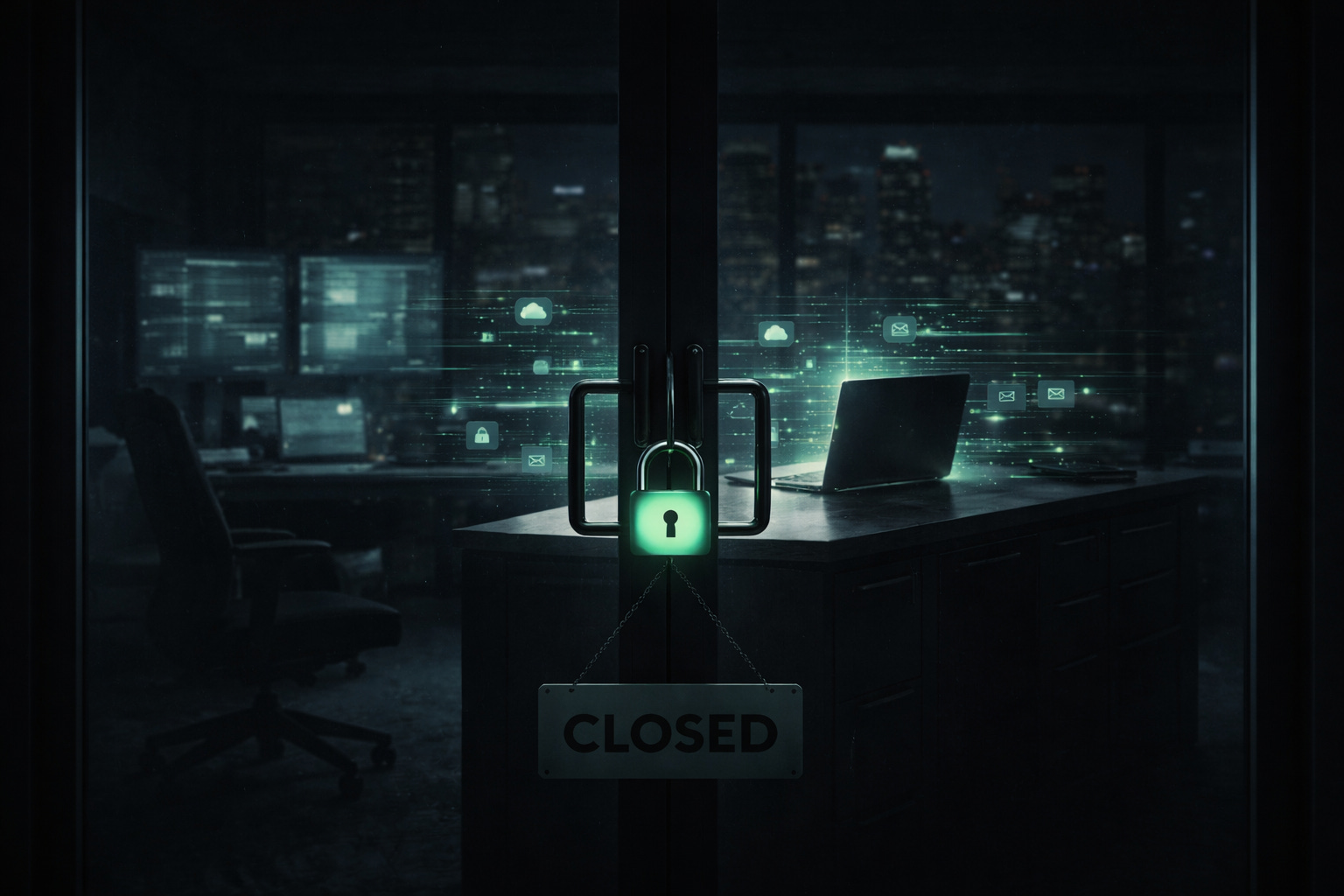
There Was a Time When Business Had an “Off” Switch
Not long ago, when a business closed for the day… it actually closed.
Doors locked.
Lights off.
Registers counted.
Access ended when the workday did.
Risk had boundaries.
Today?
That boundary doesn’t exist.
The Digital Reality Most People Haven’t Fully Processed
Your business may shut down for the day.
But your systems don’t.
Emails are still accessible
Logins are still active
Cloud platforms are still connected
Customer data is still stored
Accounts are still reachable from anywhere in the world
Even while you sleep.
Even while you’re on vacation.
Even when you think nothing is happening.
Your business is still “open” — just without supervision.
Access Is No Longer Tied to Presence
This is the shift most business owners haven’t operationalized yet.
Access used to require:
physical presence
business hours
direct interaction
Now it requires:
a login
a device
and an opportunity
That’s it.
Which means risk doesn’t wait for:
your availability
your attention
or your awareness
Why This Changes Everything About Security
Security is no longer about protecting active work.
It’s about protecting:
idle systems, stored data, and unattended access points.
This is where most businesses are exposed.
Not during peak hours.
Not during active use.
But in the quiet gaps:
overnight
weekends
vacations
busy seasons
moments of distraction
Because that’s when:
alerts are missed
decisions are delayed
and systems are left to run on autopilot
A Breach Doesn’t Just Steal Data — It Disrupts Operations
Most people think of security breaches as data problems.
They’re not.
They’re operational problems.
A breach can:
lock you out of your own systems
interrupt client communication
corrupt or expose sensitive data
damage trust and reputation
force reactive decisions and under pressure
In other words:
It doesn’t just affect your security — it affects your ability to run your business.
And the longer it goes unnoticed, the more expensive it becomes.
The Gap: Businesses That Close vs Systems That Don’t
Here’s the real issue:
Most businesses operate like they have defined hours.
But their infrastructure operates 24/7.
That mismatch creates risk.
Because while the business is:
resting
offline
or focused elsewhere
The system is:
still accessible
still exposed
still active
Without structure, this becomes:
Unmanaged access.
Unmonitored activity.
Uncontrolled risk.
This Is Why 24/7 Protection Matters
24/7 protection doesn’t mean you’re constantly working.
It means your systems are designed to hold without you.
That includes:
controlled access
monitoring that filters signal from noise
alerts that actually get addressed
clear ownership of systems
defined response expectations
This is where companies like Netizen Watch step in.
Not to overwhelm you with tools.
But to ensure your operations are supported — even when you’re not actively thinking about them.
The New Standard: Systems That Work While You’re Offline
Secure businesses don’t rely on constant attention.
They rely on:
structure
clarity
and continuity
They assume:
people will get tired
days will get busy
things will be missed
So they build systems that:
catch what humans don’t
hold what humans forget
and protect what humans are building
A Simple Reframe
Instead of asking:
“When do I need to think about security?”
Ask:
“What’s protecting my business when I’m not?”
Because in the digital age:
That’s most of the time.
Final Thought
The most dangerous assumption in modern business is this:
“Nothing is happening because I’m not working.”
In reality, everything is still running.
Access is still open.
Systems are still active.
Risk is still present.
And the businesses that thrive long-term are the ones that understand:
Security isn’t tied to your schedule.
It’s tied to your systems.